|
..
|
||||||||||||||||||||||||||||||||||||||||||||||||||||||||||||||||||||||||||||||||||||||||||||||||||||||
|
| |||||||||||||||||||||||||||||||||||||||||||||||||||||||||||||||||||||||||||||||||||||||||||||||||||||
| ||||||||||||||||||||||||||||||||||||||||||||||||||||||||||||||||||||||||||||||||||||||||||||||||||||||
.: 9-11: An Inside Job :. jar2
"9/11 was not an inside job..." - Bill Clinton 03-04-08 "Give up your kids as collateral." - Nancy Pelosi 05-07 The truth about 9-11. 284 Mbs. "PNAC=9-11, Endless | ||||||||||||||||||||||||||||||||||||||||||||||||||||||||||||||||||||||||||||||||||||||||||||||||||||||
MAIN FILES Oschenko's MI-5 debriefing reports Police Witness Statements Index 376 Pages of Police Witness Statements in the Mike Smith Case COUNT#3 EXHIBITS HTML ZIPPED PDF
The Jigsaw Puzzle of my Spy Trial by Michael John Smith
Those who remember my case will be aware that in 1992/93 I was portrayed as a major KGB spy, featuring on the front pages of several national newspapers. My name later appeared in the Mitrokhin Archive, as did Melita Norwood - the Granny Spy - but unlike her I have been largely ignored by those commentating on the history of espionage in the UK.
In this article, I would like to familiarise JAR2 readers with some key elements of my case, and to raise questions about the official Prosecution account. I maintain that I did not receive a fair trial, and this is why I am still engaged in legal action to have my case re-opened.
I was arrested on 8 August 1992, and subsequently convicted at the Old Bailey on 18 November 1993 on 3 of the 4 counts in the indictment - all related to espionage offences under the Official Secrets Act. The sentence was 25 years imprisonment, which was later reduced to 20 years by the Court of Appeal in 1995, on the basis there was no evidence whatsoever to indicate what material had been involved in 2 of the counts.
The sensitivity and value of scientific documents was an important part of the trial, taking up 3 weeks in court and involving 20 expert witnesses. The other subject on which expert witnesses were called concerned the tradecraft used by the KGB when running agents in the UK. These 2 aspects of the trial were held in camera, which meant about half the 8 week trial was hidden from public scrutiny.
The phone call A useful starting point is the phone call made to my home in Kingston-upon-Thames on the morning of 8 August 1992. An MI5 officer made the call from a house nearby in Ham, and my wife answered the phone.
Pamela Smith: Hello. Caller: Hello, is it Michael Smith? Pamela Smith: Er, he lives here, whos calling? Caller: This is George. Pamela Smith: Who? Caller: George. Pamela Smith: Just one moment. Michael Smith: Hello. Caller: Hello, is it Michael Smith? Michael Smith: Yes. Caller: Hello, I am George speaking. I am colleague of your old friend Victor. Do you remember him? Michael Smith: Yes. Caller: Ok, thats good. Now listen. It is very urgent for me to talk to you. Michael Smith: Yeah. Caller: You understand? Michael Smith: Yes. Caller: Ok, Ok, but I think maybe we do this another way. Michael Smith: Ok. Caller: You understand? Michael Smith: Yeah. Caller: Ok. I think there is telephone at the corner of Durlston Road and Cardinal Avenue. You know this? Michael Smith: Yes, yes. Caller: Ok, you can maybe be there in 15 minutes? Michael Smith: Ok. Caller: Yes, Michael Smith: Yes. Caller: Ok. This is corner of Durlston Road and Cardinal Avenue. Michael Smith: Ok. Caller: 15 minutes, very important. Michael Smith: Ok. Caller: Ok. I ring you there. Bye, bye. Michael Smith: Bye.
The caller imitated a foreign accent, variously described as foreign, East European or Russian; although my wife said she thought he was German (her first husband had been German). I did actually know a Spaniard called Victor, so the reference to that name did not immediately make me suspicious. I was not feeling particularly responsive to the caller as I was in the middle of making love to my wife when the phone rang, and we had been out late the previous night at a Greek restaurant, leaving me slightly hung over from too much wine. So, I was rather confused over what the call was about, which was why I just mirrored what George was saying.
Viktor Oshchenko The significance of the names Victor and George, used in the phone call, was not apparent that morning of my arrest. Not until many months later, in June 1993, did it become clear why those two names were important, when the Prosecution revealed they would be calling a new and anonymous witness to my trial. This witness, a US citizen referred to as Mr. E, had worked as a salesman in a hi-fi shop in Tottenham Court Road in December 1978 when the KGB officer Viktor Alekseevich Oshchenko spotted him as a potential agent and recruited him. After Oshchenko returned to the Soviet Union in 1979, Mr. E was handled by another KGB officer, Yuriy Gennadyevich Pokrovskiy (later expelled from Britain), who called himself George.
My arrest was linked to the defection of Oshchenko, who was a KGB Colonel at the Russian Embassy in Paris between 1985 and 1992 before he came to Britain. The Prosecution claimed I was recruited to the KGB by Oshchenko in the mid-1970s, when he was based in London, although no evidence has ever been produced to show I met him. Stella Rimington, referred to as Mrs C during the trial (she was then MI5 Section Head in charge of studying hostile intelligence agencies), said under oath there was no evidence I had ever met anyone in the KGB. Rimington said Oshchenko arrived in Britain on 29 August 1972 to work at the Soviet Embassy as a 3rd Secretary, but he was identified as an agent-running KGB officer within 12 to 18 months. He was allowed to remain in Britain for a further 5½ years until his duties ended, on 22 September 1979.
During the police interviews that followed my arrest, there was a strong hint that the chronology of events was different. My interrogator, a senior Special Branch officer, asked me if I was aware of the archive leaks that had taken place in Russia. At that time I did not understand what he referred to, but over 7 years later it emerged that Vasili Mitrokhin had decided to defect some months before Oshchenko. So was it Mitrokhin or Oshchenko that had led to my arrest?
Judge John Blofeld agreed that it was admissible for the Prosecution to tell the jury that the Victor mentioned in the phone call - no surname given - could be assumed to refer to Viktor Oshchenko. This allowed the prosecution to present a whole raft of speculative assertions about my past, going back to the 1970s, and to suggest that events associated with Mr. E were very similar to events in my own life. These similarities were very tenuous, but the main point the prosecution wished to make was that I had gone to Oporto (Portugal) on a KGB training mission.
Mr. E and the Portugal connection Mr. E was born in Yorkshire; his mother was an English nurse and his father a retired US Army 0-6. He had spent some time in the US Navy, leaving as a Petty Officer (electronics technician (radar) III class), and it seems the Russians were interested in Mr. Es background as well as his relatives - his father-in-law worked with one of the US House of Representatives subcommittees. One reason for targeting Mr. E was the KGBs plan to groom him as a long-term mole, so he could work against the main enemy when he returned to the United States. Mr. E was put on the KGBs payroll, and received a regular salary equivalent to the monthly mortgage payments on his home.
While working for the KGB, Mr. E attempted to procure some sensitive integrated circuits, which were proscribed to the Russians under COCOM. He was also trained in KGB tradecraft methods (such as making contact via telephone kiosks) and he sought to improve his professional position with Russian help and money, which might gain him access to information useful to Russian Intelligence. One of Mr. Es training missions was a trip to Lisbon on the weekend of 21/22 July 1979, to deliver a sealed package to a KGB contact.
The Prosecution used Mr. Es Portuguese trip to claim I did the same in August 1977, when I was on a camp-drive holiday with a friend. I was in the habit of saving old maps and leaflets from my holidays, and unfortunately I retained a marked map given to us by a camp-site attendant - this map indicated 3 bus stops we had used to travel to the camp-site, and a tourist restaurant called O Fado, where we enjoyed an evening of Portuguese food and entertainment. Both Oleg Gordievsky and Stella Rimington claimed this map was typical tradecraft used when a KGB officer meets an agent.
In early May 1980, Mr. E reported his activities with the KGB to the US embassy (London), and was then run by MI5 for some months. Mr E last saw Oshchenko in 1979, and he met him about 10 times, yet in June 1993 Mr. E was able to identify Oshchenko from a photograph, although it was stated by American and British Security Service personnel that Mr. E had an atrocious memory. Mr. E admitted he enjoyed reading books about espionage and he offered to work as a double-agent - it seems he is a sort of Walter Mitty character.
Oshchenko - the missing witness With so many references to Oshchenko during my trial, the jury recognised his importance in the case. It was a surprise to those following my trial, as well as to the jury, when it became apparent that Oshchenko was not a Prosecution witness. The jury were also clearly disturbed that the Prosecution had not supported their assertions with evidence, and near the end of the trial the jury sent 2 notes to the judge:
(i) After the Prosecution had presented their case and near the end of the Defence case, on 5 November 1993, they asked: What evidence is there that Smith was recruited to KGB by Oshchenko?
(ii) Two hours into their deliberations on 16 November 1993, they asked: Why is there no explicit statement admissible in court, from Victor accusing Smith of spying for the Russians?
The jury were right to have their doubts because Stella Rimington accepted, under cross-examination, that no espionage equipment had been found in my possession: there were no cameras, microdots, secret writing materials, code books, radio transmitters, secret containers (such as false bottomed brief-cases), etc. Nothing was found that would indicate I was operating as a professional spy.
However, in the judges ruling on evidence admissibility, this phantom witness Oshchenko allowed the Prosecution to present a list of prejudicial points and assertions which undermined my credibility and character in the jurys eyes:
* I was a member of the Communist Party in the early 1970s. * Oshchenko was a KGB officer in London in the 1970s and had defected in 1992. * Oshchenko recruited me as a KGB agent in the mid 1970s. * Oshchenko trained me in tradecraft techniques. * Oshchenko told me to break with left wing activity. * Oshchenko directed me to find work on government projects. * I worked on a secret weapons project at EMI in the 1970s (not part of the charges). * The KGB paid me money in the 1970s. * I had a holiday in Oporto in 1977, allegedly a KGB training mission. * Portugal was used by the KGB for training agents. * I lost my security clearance at EMI in 1978. * I attempted to conceal my previous CP membership to regain security clearance in 1979/80. * The KGB put me on ice until 1990.
Dirty tactics Holding my trial in camera effectively prevented the public from knowing that my case involved no secrets, and that a KGB connection was speculative rather than proven. This was also a hidden message to the jury that the evidence was so potentially damaging to national security that it could not be revealed in public.
Although the charges related only to the period 1990-92, the Prosecution used character assassination as a tactic. Two examples illustrate this: (a) It was claimed I lied on a job application form before joining EMI in 1976. This was completely untrue and no evidence was produced, but the jury were given the impression that I had obtained the job illegitimately. (b) I had 2 private meetings at EMI and the MoD to discuss my security clearance. These meetings were recorded without my knowledge and the original tapes destroyed. However, transcripts of these meetings were analysed in court and used to denigrate my character. The meetings were held on 12 November 1979 and 10 June 1980, i.e. over 12 years before my arrest.
All my lawyers telephones were bugged, from the time of my arrest until after my trial ended. This meant my lawyers had to communicate clandestinely, to avoid the Prosecution discovering the Defence teams strategy.
Oleg Kalugin, former Head of Soviet Counter Intelligence, was about to be the key Defence witness when he arrived at Heathrow on 30 October 1993. Kalugin was arrested at the airport and interrogated for hours on suspicion he may have been involved in the 1979 Georgi Markov umbrella murder in London. Although released without charge, the resulting bad publicity destroyed Kalugins credibility, and my lawyers decided not to call him. Kalugins evidence would have been that my case did not have the hallmark of the KGB.
MI5 entrapment? I had been a member of the Communist Party of Great Britain (CPGB) between 1972-5, but I became disillusioned with their politics and resigned. I was later given security clearance and worked on defence projects at EMI Electronics until May 1978, when I lost my clearance and was moved to another part of the company. I was unaware I had lost my security clearance, but in early November 1979, shortly after starting a mortgage and buying a flat, interest rates had rocketed and I faced redundancy at work. When I learned of my lost security clearance, I tried unsuccessfully to get it re-instated to improve my employment prospects. But after 1980 my work situation stabilised, and I simply got on with life, assuming I had lost security clearance forever. I had no idea when I joined Hirst Research Centre in 1985 that I was granted a low level of security clearance.
Throughout the 1980s I had the distinct feeling I was under some sort of covert surveillance, through my awareness of odd phone calls and strangers acting suspiciously near my home. Later, following my trial, it was admitted that MI5 had put me under surveillance from 1977 until 1992.
Then, in January 1990, I was lured into an industrial espionage operation by a man calling himself Harry Williams; he was very persuasive and bribed me with £20,000, at a time when I was in financial difficulties. The money was given to me in brand new, large denomination £50 notes, in sequential serialised batches; this money was traced to several UK and New York banks. Although the money was apparently traceable, the Prosecution at my trial said it was impossible to link it with a KGB source - I believe there is a distinct possibility this money came from MI5 or Special Branch, as other evidence indicated the KGB would only deal in small denomination, used notes.
I was directed to meet Harry Williams at sites known to MI5, and which Oleg Gordievsky had previously used himself to meet or leave messages for agents. I even kept a letter that Williams posted to my home (which was used in evidence). The suspicious circumstances of my surveillance and arrest make me believe everything had been planned by MI5, and that Harry Williams was a MI5 officer pretending to be involved in industrial espionage.
Stella Rimington said that, as my meetings with Williams were covertly organised, this was sufficient proof that a foreign and hostile intelligence agency was behind it. Rimington also said MI5 was not concerned with industrial espionage, nor with the operations of friendly intelligence agencies.
Gordievsky was briefed about my case on 19 August 1992, when he was given a typed summary of MI5s interpretation of the facts in the case. He agreed to help the Prosecution, and completely accepted MI5s version of the story. Gordievsky said he recognised rough notes I made, the so-called tradecraft notes of my meetings with Harry Williams, as very familiar to him. Although individual details in the notes could be used by anyone, or any intelligence agency, Gordievsky said that, taken as a whole, he recognised the pattern as typical of the KGB.
A puzzling aspect of Gordievskys position was his claim he had never heard of me - despite the Prosecution case I worked for the KGB from the mid-1970s to early 1990s. Gordievsky was the KGB Rezident in London from 1982-5, and he claimed to have exposed all their agents when he defected in 1985. His answer was that he had not known all the KGBs spies in Britain, as they didnt keep a list of them. This does not seem credible, as Oshchenko told MI5 the KGB only had about 5 agents at any one time in London in the 1970s.
In court, Gordievskys reliability was questioned by the Defence: he was known to exaggerate and is well-known for seeking publicity. He has also been a public supporter of MI5 and MI6, and he admitted he was paid a pension of £1,500 a month after he defected.
The Defence called an ex-CIA Station Chief, referred to as Mr P, as a witness at my trial. Mr. P was an expert in tradecraft skills, and he disagreed with Gordievsky and Rimington by saying his opinion was my case could not be linked with the KGB - it was too amateur an operation - and he listed 14 points which indicated it was unlikely I had any involvement with the KGB. Bill Colby (former Director of the CIA) and ex-CIA officer Philip Agee also agreed it would not be possible to say that the tradecraft in my case was exclusive to the KGB - the CIA used the same techniques, as might any other intelligence agency, or anybody involved in clandestine activity other than espionage. There is also the possibility that the tradecraft could have been used as a false flag, to give the impression that a foreign intelligence agency was involved, and this could have been set up by MI5 or some other British agency.
Shifting goalposts Following my arrest, the 4 days of police interviews seemed to be leading to spying charges during 1976-8, when I worked at EMI Electronics on the project to develop a new trigger mechanism for Britains free-fall nuclear bomb (WE-177). However, I was never charged with any offence relating to the WE-177 project, and it played no part in my trial in 1993.
The Prosecution realised there was no evidence to charge me with offences at EMI, and so the focus switched to my work at Hirst Research Centre, because a small quantity of old GEC-Marconi documents had been found at my home. With my low level of security clearance, and little access to anything sensitive, it was not surprising that the documentary exhibits used to convict me were largely unclassified and non-sensitive, and not even of military significance.
The Defence expert, Dr Eamonn Francis Maher, proved that most of this material was not sensitive, and much was already in the public domain. However, the Prosecution persisted in presenting a mass of expert evidence, which could only have confused the jury.
The most significant item found in my possession was one 10 year-old document - dated 8 January 1982 and marked restricted - the only classified material involved in the whole of my case. This document did not identify its exact use, but it bore the name and address of Marconi Space & Defence Systems (Stanmore), who had produced the document. The restricted document had been issued to a colleague of mine, F.S. McClemont, but strangely neither Mr. McClemont, nor the other 15 recipients of the document, were asked to give any evidence about it. Surprisingly, no witnesses from Marconi were asked to comment on the use or significance of this document.
No evidence was disclosed to the Defence about the restricted document for 14 months after my arrest, and the Prosecution gave the impression that it would not play an important part in their case. Then, in an apparent ambush tactic, the Prosecution suddenly revealed undisclosed evidence through MoD scientist Professor Meirion Francis Lewis. Professor Lewis was the only Prosecution witness to give significant testimony on the restricted document, and he claimed he could personally identify its use on Britains ALARM missile.
Professor Lewis also claimed the document would enable an enemy to jam ALARM, which would put British lives at risk. He further claimed that Saddam Hussein had switched off his radar systems during the Gulf War (1991) due to ALARM. Professor Lewis said Marconis Technical Director had personally confirmed the documents link to ALARM in a telephone conversation on the morning he gave evidence. No ALARM expert was used by the Prosecution, and, as an electronics engineer myself, I doubted Professor Lewiss deductions. After conducting my own research I have been able to prove that many of Professor Lewiss claims are incorrect.
Under cross‑examination, Professor Lewis admitted he was not an expert in missile technology, nor in jamming, and when he was in danger of revealing too much information about the restricted document, Dr. D. I. Weatherley (a senior MoD observer present throughout the trial) made the Prosecution stop the cross-examination. The reason given was the questioning was going into secret matters, although the trial was held in camera so that such issues could be discussed. This left some major questions about Professor Lewiss evidence unresolved.
Defence expert, Dr Maher, identified that the restricted document was in fact a specification for a SAW filter component, which he recognised as a commercial product on general sale, and listed in a GEC sales catalogue.
It is suspicious that the Security Commissions report into my case (HMSO, Cm 2930, July 1995) states of the restricted document that: at the time the document was created it was not specifically linked to a particular weapons system (Annex A.5). I have tried unsuccessfully, including a parliamentary question from Mr. Andrew Mackinlay M.P., to get the MoD to confirm that the restricted document was used on the ALARM missile. The document is now 24 years old, but I am still waiting for official acknowledgement that the evidence given at my trial was correct.
Conclusion MI5 was implicated in entrapment operations in the spy cases of Rafael Juan Bravo (2001) and Ian Parr (2002). Within days of the arrest of those two individuals, the military projects involved in their cases were quickly identified and published in the media. Although these cases involved highly classified documents and current projects - compared to low classification and old documents in my case - Bravos sentence of 11 years, and Parrs of 10 years, were half the sentences given to me.
In 1998, the ex MI6 officer Richard Tomlinson said he saw an internal MI5 report, which concluded my case did not involve damaging secrets. Mr Tomlinsons view was that MI5 had exaggerated the alleged damage in my case in order to secure a long sentence, and to cultivate the mystique of the importance of their work.
It is interesting what Richard Tomlinson had to say, because he was confirming MI5 had come to the same conclusion as that arrived at in the original MoD damage assessment report (dated 7 March 1994), which the MoD prepared for the Security Commissions investigation into my case. The MoD said that the level of damage was assessed as not serious damage. It was surprising therefore, at my appeal in May 1995 (some 14 months later), the MoD suddenly changed their assessment to one that serious damage had been caused, and it was claimed the restricted document should have been classified secret - not an issue mentioned at my trial.
Stella Rimington said Oshchenko was not a double-agent prior to his defection in July 1992, and neither did he pass information to the Security Services before his defection. This may be true, but her testimony has been contradicted by claims made in several books, which indicate that Oshchenko had been working for British Intelligence long before he defected. Perhaps this was the reason why Oshchenko has disappeared from view, and why he was not a witness at my trial?
M ore details at: Mike Smith's Case or at www.parellic.blogspot.com
First Published on JAR2 02-13-06 I recently received information regarding the case below and am requesting any parties with information related to the case to contact me. Thank you in advance, anonymity guaranteed. SEE: Mike Smith Espionage Case Spy indictment: Official Secrets Act It may not be known to the readers of my blog what was actually involved in my case and trial, and exactly what I had been accused of doing that led to my conviction for espionage. The Indictment was worded as follows: The Crown Court at Central Criminal Court The Queen -v- Michael John Smith Michael John Smith is charged as follows: COUNT 1 Statement of Offence Communicating material to another for a purpose prejudicial to the safety or interests of the State, contrary to Section 1(1)(c) of the Official Secrets Act 1911. Particulars of Offence Michael John Smith on a day between the 1st day of January 1990 and the 1st day of January 1991, for a purpose prejudicial to the safety or interests of the State, communicated to another a sketch, plan, model, article, or note, or other document or information which was calculated to be or might have been or was intended to be directly or indirectly useful to an enemy. COUNT 2 Statement of Offence Communicating material to another for a purpose prejudicial to the safety or interests of the State, contrary to Section 1(1)(c) of the Official Secrets Act 1911. Particulars of Offence Michael John Smith on a day between the 1st day of January 1991 and the 1st day of May 1992, for a purpose prejudicial to the safety or interests of the State, communicated to another a sketch, plan, model, article, or note, or other document or information which was calculated to be or might have been or was intended to be directly or indirectly useful to an enemy. COUNT 3 Statement of Offence Making a sketch or note for a purpose prejudicial to the safety or interests of the State, contrary to Section 1(1)(b) of the Official Secrets Act 1911. Particulars of Offence Michael John Smith between the 30th day of April 1992 and the 8th day of August 1992, for a purpose prejudicial to the safety or interests of the State made sketches or notes which were calculated to be or might be or were intended to be directly or indirectly useful to an enemy. COUNT 4 Statement of Offence Obtaining or collecting material for a purpose prejudicial to the safety or interests of the State, contrary to Section 1(1)(c) of the Official Secrets Act 1911. Particulars of Offence Michael John Smith between the 30th day of April 1992 and the 8th day of August 1992, for a purpose prejudicial to the safety or interests of the State obtained or collected sketches, plans, models, articles, or notes, or other documents or information which were calculated to be or might have been or were intended to be directly or indirectly useful to an enemy. There was no evidence at all about what scientific material was involved in Counts 1 and 2. I volunteered information that it related only to obsolete and unclassified commercial documentation, concerning silicon-on-sapphire and gallium arsenide technology. HRC (Hirst Research Centre) abandoned these technologies at Wembley in the late 1980s, and it would not be useful to an enemy. However, the Prosecution claimed, without any evidence, that the material must have been militarily sensitive - it is difficult to see how they arrived at such a conclusion. Count 3 related to my handwritten notes: JS/16 Rugate Filter Project (pp. 176-178) JS/17 Micro-Machining Project (pp. 179-181) JS/18 Quasi-Optical Car Radar Project (pp. 182-185) JS/19 Micron-Valve Project (p. 186) JS/20 Olfactory Research Project (p. 187) I could go into great detail about the type of material found in Count 3, and the long prosecution and defence arguments about whether the Russians would have found it useful or not, or whether it was prejudicial to the UK. In the end these projects were potentially capable of dual commercial or military use (as is almost anything if you think about it), but there was insufficient evidence that I had either intended to hand this information to a Russian, or it was of real technical value to an enemy. After deliberation the jury used their common sense, and they rejected the prosecution claims. Although all the scientific exhibits were in the same bag in the boot of my car, I was found not guilty of Count 3, but guilty of Count 4. Count 4 related to GEC components and printed documents: JS/14 Old surface acoustic wave, silicon-on-sapphire and gallium arsenide components (p. 1) JS/15 Surface acoustic wave documents (pp. 2-175), including a RESTRICTED ALARM document (pp. 51-59) JS/21-38 Bulk acoustic wave documents (pp. 188-269J), including an UNCLASSIFIED Rapier document (pp. 190-196) SR/4 Infra-Red Imager documents (pp. 269/1-269/9) SR/4 Silicon-on-sapphire documents (pp. 269/10-269/69) SR/4 Gallium arsenide documents (pp. 269/70-269/87) The components of JS/14 were old and obsolete examples (some labeled as non-working rejects) that had been lying around in my office. Since they would probably have been thrown away in any case, when the company moved site a few months later, I took them as souvenirs of my time at the company. The prosecution made the case that these components would have been useful to the Russians (for reverse engineering). However, as my expert Dr Eamonn Maher quite correctly pointed out, far more advanced and current examples of these devices were on open sale commercially - so why would a Russian be interested in obsolete material? The documents in JS/15 was a collection of information from an approval exercise to qualify Hirst Research Centre to commercially produce similar surface acoustic wave devices, and to earn the company a certificate to meet a British Standard for this manufacturing capability (BS9450 Capability Approval Exercises in 1984). There was nothing apparently of significant military interest in this collection of documents, or so the defence was led to believe by the lack of any evidence from the prosecution, until the moment Dr Meirion Francis Lewis stepped into the witness box on 7 October 1993 and delivered his radically different view using undisclosed evidence. The issue revolved around whether one 9 page document related to the ALARM missile project. Readers of this blog will be aware that more than 12 years later the Ministry of Defence has yet to officially confirm the document was used on ALARM (Mr Andrew Mackinlay, my MP, asked a question in the House of Commons recently, but failed to get an answer). As I have stated previously, the conclusions of the Security Commissions report were that 'at the time the document was created it was not specifically linked to a particular weapons system (HMSO Cm 2930, Annex A.5, July 1995). Apart from the link to ALARM there were many errors and inconsistencies in Dr Lewiss testimony about that document, and this is also awaiting resolution. Documents in JS/21-38 related to a small bulk acoustic wave delay line, and some of that information referred to a component from a piece of test equipment used to test the Rapier system - a sort of go/no-go test. However, this documentation was also part of a BS9450 Capability Approval application in 1984. The documents gave details of the frequency band used by Rapier, but did not reveal the actual spot frequencies of any installation, as each Rapier system has a different operating frequency. The sensitivity of this information can be judged from the fact that it was openly published in Janes Land Based Air Defence Review, which printed how a version of Rapier, called Possum, uses the frequency band 3.1 to 3.3 GHz and that Rapier works in the F-Band frequency range. Many other technical points were published about Rapier in this Janes book, which can be purchased or read in a public library by any Russian who cares to look for it. The 5 page UNCLASSIFIED Rapier document, dated 11 January 1984, was a procurement specification for a BAW (bulk acoustic wave) delay line. BAW delay line technology is well known, and at the trial it was stated that the component was to become obsolete. It is interesting that delay line specifications were openly published by GEC Marconi in a Techbrief, a glossy hand-out for customers, which states that typical delay lines can be manufactured with a 3.1 to 3.4 GHz frequency band. Any potential customer could request this leaflet, or buy a similar component. It is also significant that the main expert called to give evidence about the technical aspects of Rapier, ex-Squadron Leader Colin Bagley, was not himself particularly well-qualified to give that evidence. My own expert Dr Eamonn Maher made a comment that the prosecution expert whose qualifications least impressed him was Colin Bagley. It is a strange and inexplicable fact that, despite ALARM and Rapier being the two specific weapons referred to at my trial, there were no witnesses called who were authoritatively expert on the design and performance of those weapons. Perhaps the prosecution was afraid of asking experts who might actually know the true significance of the documents used as exhibits at my trial? If we are to believe the hawk-like vision of experts like Dr D.I. Weatherley, ex-Squadron Leader Colin Bagley and Dr M.F. Lewis, then Rapier and ALARM can be jammed by using some pretty basic information from Janes Land Based Air Defence Review (in the case of Rapier), and the specification of one commercially available component (in the case of ALARM). It seems incredible, if true, that Rapier and ALARM are so easy to jam, and that the UK has wasted hundreds of millions of pounds on such vulnerable systems. From my technical viewpoint I believe more than a little exaggeration was going on here, but unfortunately I am prevented from telling you more due to the gagging orders governing the in camera nonsense used at my trial. The SR/4 Infra-Red Imager documents involved an overview of the assembly of the T.I.C.M. (Thermal Imager Common Module) using SPRITE Infra-Red detector devices. So much information is already published about Infra-Red Detectors (10,000 papers), that my own expert (Dr Eamonn Maher) said the Russians would be far more interested in the information already available in the public domain, than the simple and limited information in the few pages in my possession. Dr Maher should know what he was talking about, because he was a specialist in this area himself, but the Crown insisted on going into every tiny detail, as they did in everything else. The prosecution tried to make insignificant details look highly damaging to the Nation, even though Britain allows the U.S. and Japan (a former enemy) to manufacture these detectors under licence. Most of the information only concerned the detectors assembly into its cooling jacket and could not be sensitive. The remaining parts of SR/4, concerning silicon-on-sapphire and gallium arsenide documents, was shown by Dr Eamonn Maher to be of commercial interest and already available in the public domain. So, in my opinion, the prosecution case boiled down to one 10 year-old RESTRICTED document (claimed to be from the ALARM project), and one 8 year-old UNCLASSIFIED document for a component used on a piece of Rapier test gear. To a person educated in electronic engineering, such as myself, it was quite shocking to hear allegedly well-qualified experts making claims that material already in the public domain was sensitive. There were some extraordinary things said in court. At the end of my trial the sentences passed were as follows: Charge 1: Passing information 1st January 1990 to 1st January 1991 - 8 years Charge 2: Passing information 1st January 1991 to 1st May 1992 - 8 years Charge 3: Making Notes and sketches 30th April 1992 to 8th August 1992 - Not Guilty Charge 4: Obtaining material 30th April 1992 to 8th August 1992 - 9 years Rather than, as is usually the case, making the sentences run concurrently, the judge made them consecutive. It was clear that it was only possible to find me guilty of counts 1 and 2 because of the material involved in Count 4, but that material was mostly in the public domain or of low scientific value. There was no evidence of what material I passed on charges 1 and 2 and so it is impossible to prove that it was useful to an enemy and prejudicial to the interests of the State. However, the learned judge sentenced me on the basis that he was bound to assume that, having regard to the payments received for the documentation passed over, that the material passed over was sensitive. At my appeal these sentences were both reduced to 5½ years each. The sentences can be seen to be excessive when it is considered that I only had security clearance to CONFIDENTIAL level, although there is no evidence I had access to anything above RESTRICTED status. The sentences are more appropriate to the Cold War period for a high level member of the armed forces or government services who had disclosed SECRET or TOP SECRET material to a hostile and active enemy. At the time of my trial, due to the recent political changes, Russia was no longer considered a potential enemy (according to Margaret Thatcher).
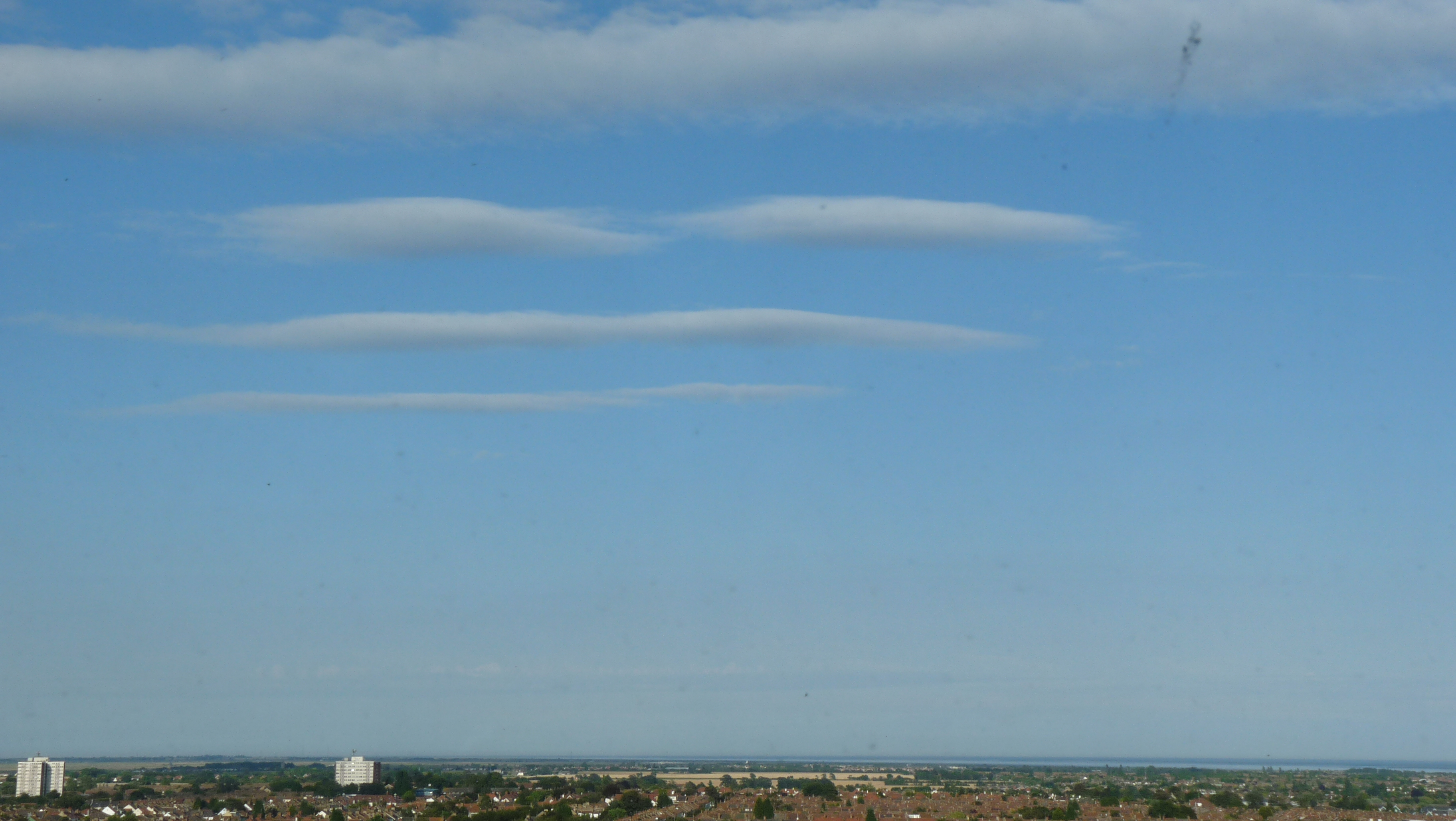
Some Photos by Mr. Smith
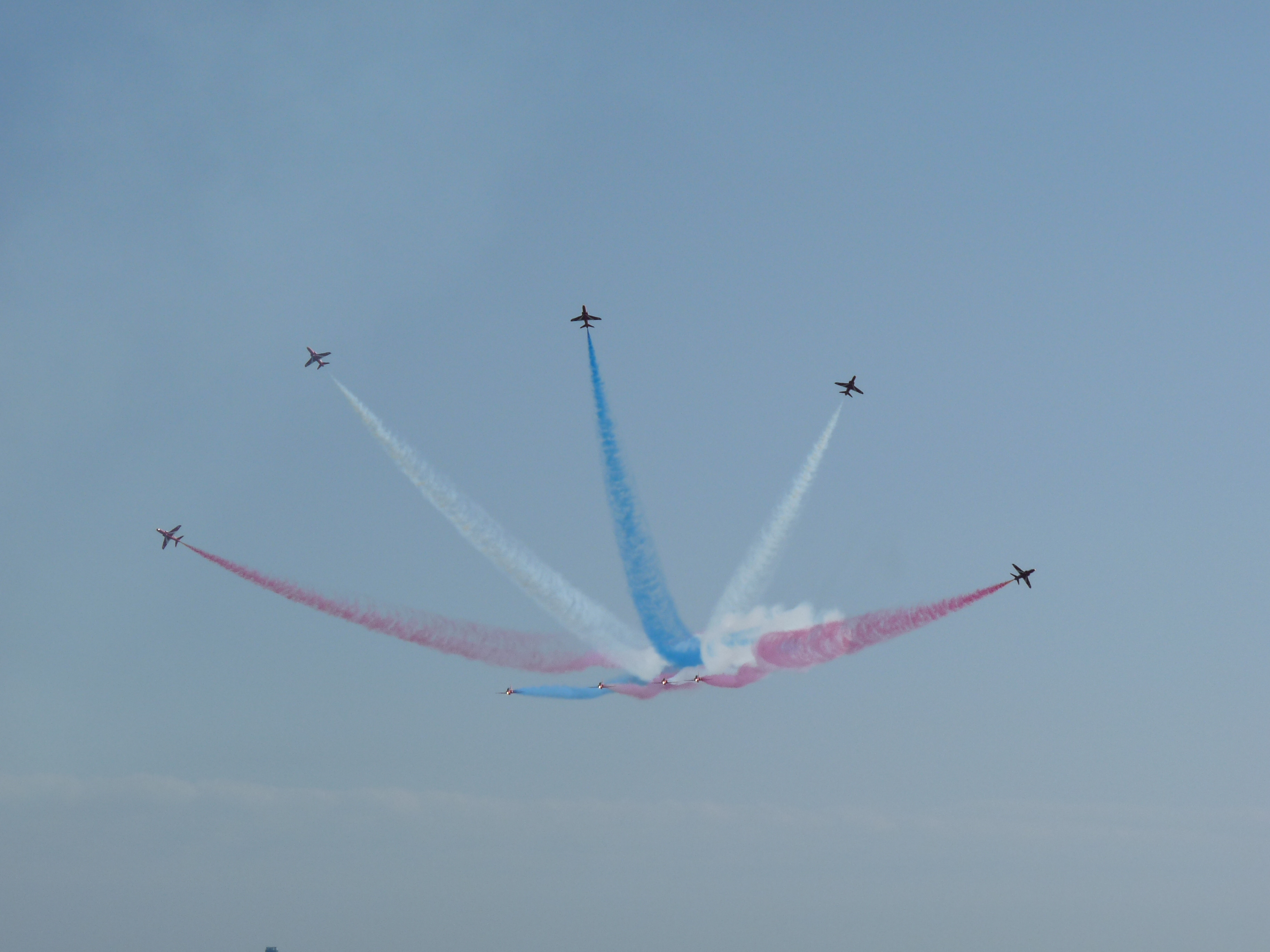
Mike Smith sent us this picture he took yesterday of the Red Arrows doing a starburst at the Southend Festival of the Air '09, in Southend-on-Sea, Essex, England, UK http://www.raf.mod.uk/reds/ http://www.southendairshow.com/
|
Copyright JAR2 2003-2103 All Rights Reserved Publishing Banned Truth Since June 06, 2003
|