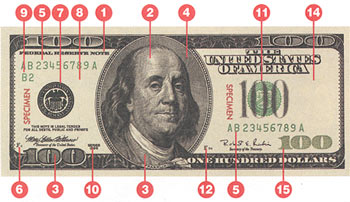
New Bucks, Old Bucks, Big Bucks
|
You see how the Illuminati use God to bring you into obedience. In their
twisted Satanic scheme of control
and slavery they equate the power of the dollar and the state to the power
of the Great Spirit/God. God has nothing to do with power and money. Money
is the tool of Moloch or Satan and therefore should be rejected by any human
who fears or follows God. God is not money. God is love, GOd is inside you
and all around you. Money is truly the root of all evil from the beginning
of time but the human race is enslaved to the system created by the Devil

Tetragrammaton YHWH (Hebrew:
יהוה)
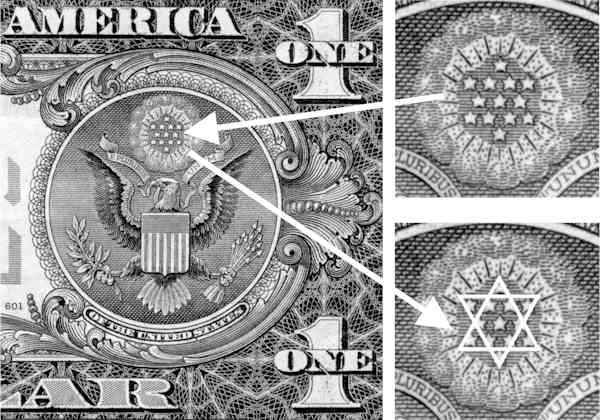

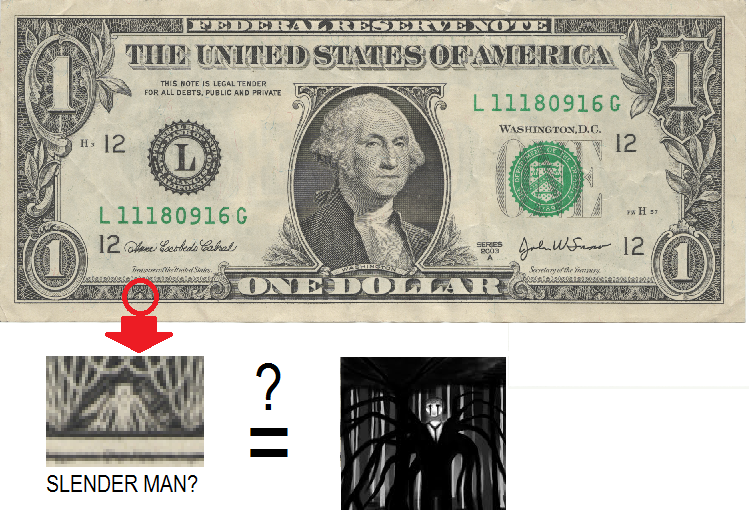
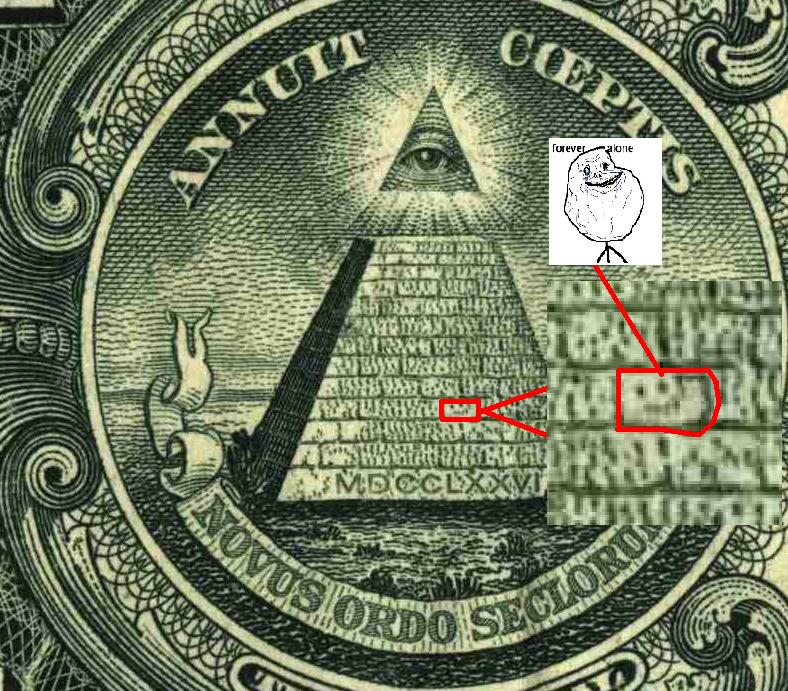
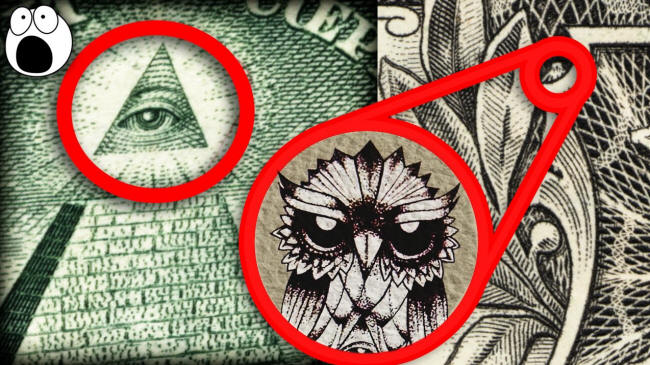
|
|
William McKinley
|
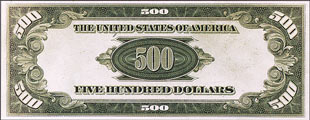
Ornate "500"
|
|
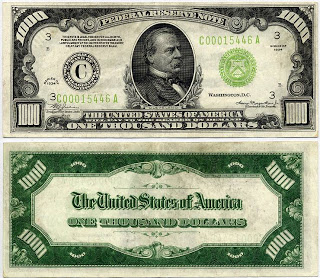
Grover Cleveland
|
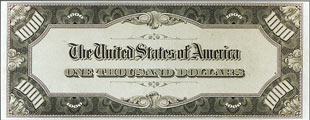
Ornate "1,000"
|
|
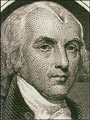
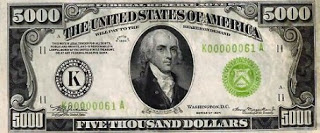
James Madison
|
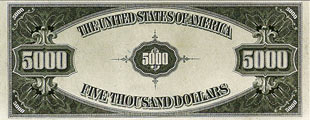
Ornate "5,000"
|
|
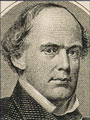
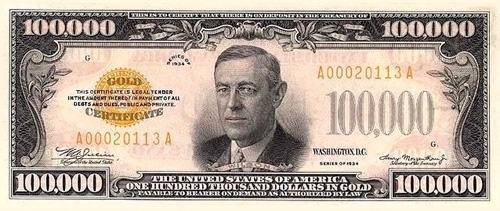
Salmon Chase
|
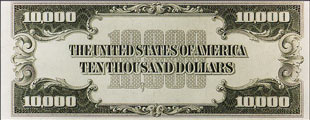
Ornate "10,000"
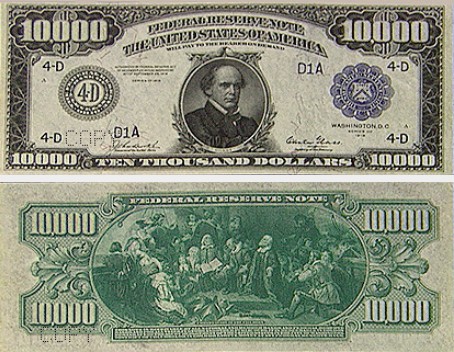
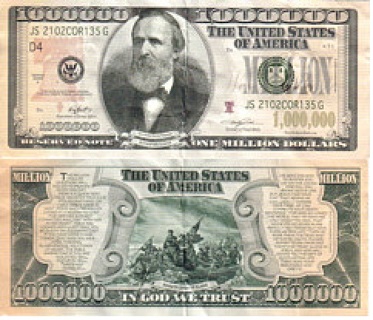
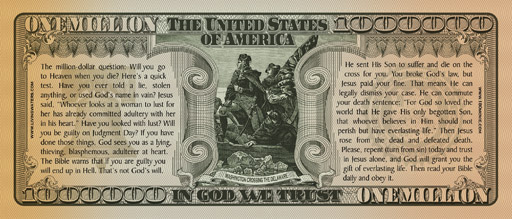
THIS IS FAKE BUT
ILLUSTRATES ILLUMINATI MANIPULATION
|
Characteristics of United States Paper Currency Three types or classes
of U.S. paper currency are in use today. The most numerous--accounting
for 99 percent of the total value in circulation--are Federal Reserve
Notes. Most of the remainder are United States Notes and Silver
Certificates, which are occasionally seen but are no longer produced.
The designation of the class to which the note belongs appears on the
upper center of its face. Each type is identified by the distinctive
color of its Treasury seal and serial numbers. On Federal Reserve Notes
these are green, on United States Notes they are red, and on Silver
Certificates they are blue.
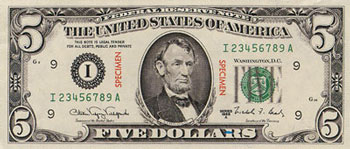 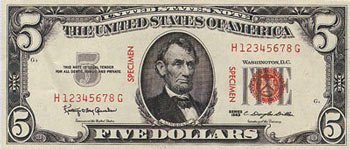
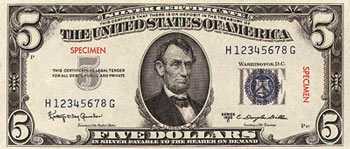
Each denomination, regardless of class, has a
prescribed portrait and back design selected by the Secretary of the
Treasury. Notes of the $500, $1,000, $5,000, and $10,000 denominations
have not been printed for many years and are being withdrawn from
circulation. The portraits appearing on these notes are: McKinley on the
$500, Cleveland on the $1,000, Madison on the $5,000, and Chase on the
$10,000.
How To Detect Counterfeit Money The public has a
role in maintaining the integrity of our currency. You can help guard
against the threat from counterfeiters by becoming more familiar with
United States currency. Look at the money you receive. Compare a suspect
note with a genuine note of the same denomination and series, paying
attention to the quality of printing and paper characteristics. Look for
differences, not similarities.
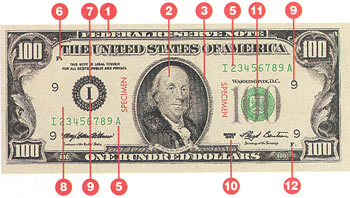
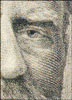
The genuine
portrait appears lifelike and stands out distinctly from the background.
The counterfeit portrait is usually lifeless and flat. Details merge
into the background which is often too dark or mottled.
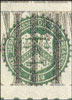
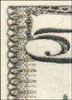
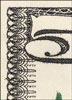
On a genuine bill, the saw-tooth points of the
Federal Reserve and Treasury seals are clear, distinct, and sharp. The
counterfeit seals may have uneven, blunt, or broken saw-tooth points
The fine
lines in the border of a genuine bill are clear and unbroken. On the
counterfeit, the lines in the outer margin and scrollwork may be blurred
and indistinct.
Genuine
serial numbers have a distinctive style and are evenly spaced. The
serial numbers are printed in the same ink color as the Treasury Seal.
On a counterfeit, the serial numbers may differ in color or shade of ink
from the Treasury seal. The numbers may not be uniformly spaced or
aligned.
 
Genuine
currency paper has tiny red and blue fibers embedded throughout. Often
counterfeiters try to simulate these fibers by printing tiny red and
blue lines on their paper. Close inspection reveals, however, that on
the counterfeit note the lines are printed on the surface, not embedded
in the paper. It is illegal to reproduce the distinctive paper used in
the manufacturing of United States currency.
 
The New Color of Money: Safer,
Smarter, More Secure. In keeping with the strategy of maintaining the
security of our currency by enhancing the designs every 7 10 years, a
new series of U.S. currency will be issued, beginning with the $20 note
later this year, followed by the $50 and $100 notes 12 18 months later.
For more information about the new currency designs, please
click here.
|
|
|
|
|
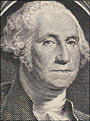
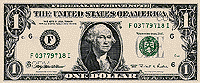
One Dollar
Note
George Washington
|
|
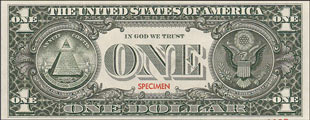
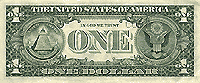
One Dollar
Note
Great Seal of the United States
|
|
|
|
|
|
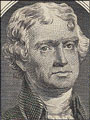
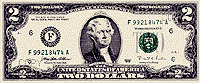
Two Dollar
Note
Thomas Jefferson
|
|
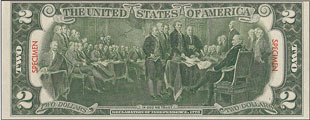
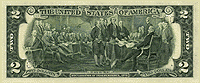
Two Dollar
Note
The Declaration of Independence
|
|
|
|
|
|
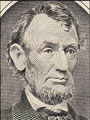
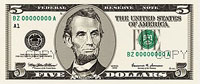
Five Dollar
Note
Abraham Lincoln
|
|
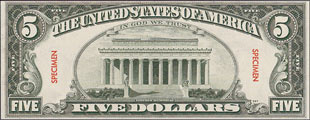
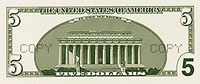
Five Dollar
Note
The Lincoln Memorial
|
|
|
|
|
|
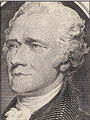
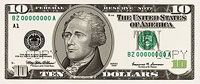
Ten Dollar
Note
Alexander Hamilton
|
|
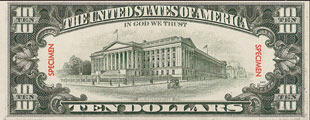
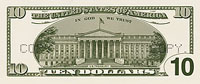
Ten Dollar
Note
U.S. Treasury
|
|
|
|
|
|
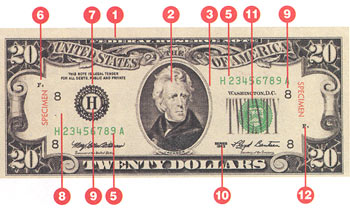
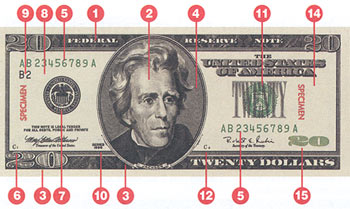
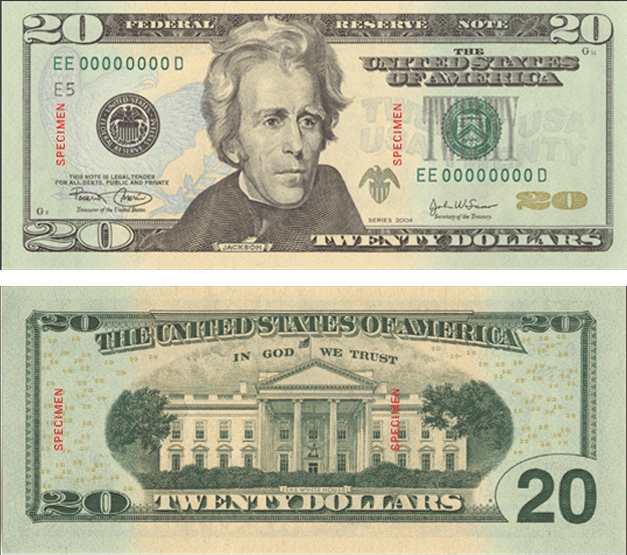
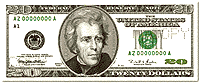
Twenty Dollar
Note
Andrew Jackson
|
|
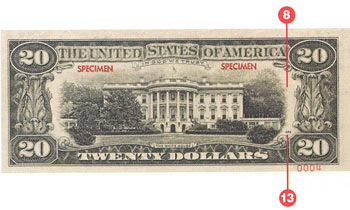
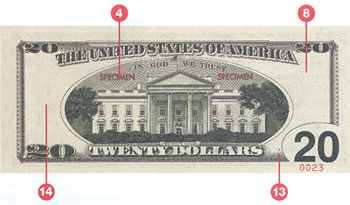
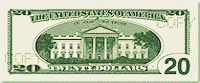
Twenty Dollar
Note
The White House
|
|
|
|
|
|
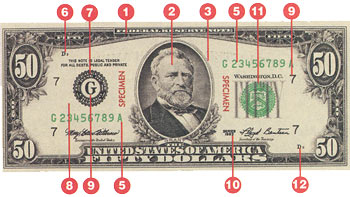
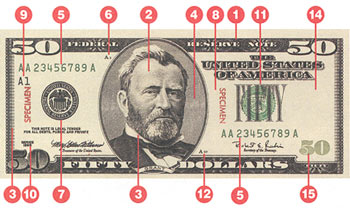
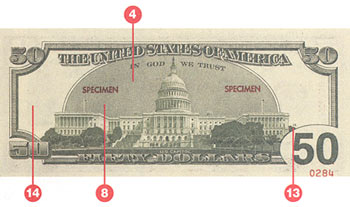
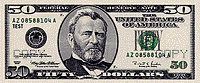
Fifty Dollar
Note
Ulysses S. Grant
|
|
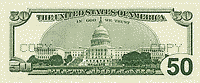
Fifty Dollar
Note
U.S. Capitol
|
|
|
|
|
|
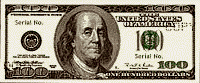
One Hundred
Dollar Note
Benjamin Franklin
|
|
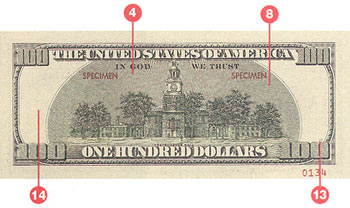
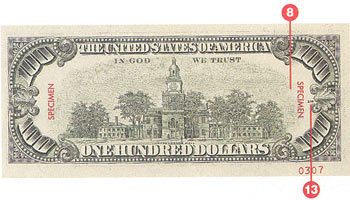
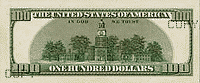
One Hundred Dollar Note
Independence Hall
|
Intaglio
Printing The Bureau prints currency on high-speed, sheet-fed rotary
presses which are capable of printing over 8,000 sheets per hour.
Printing plates are covered with ink and then the surface of each plate
is wiped clean which allows the ink to remain in the design and letter
grooves of the plates. Each sheet is then forced, under extremely heavy
pressure (estimated at 20 tons), into the finely recessed lines of the
printing plate to pick up the ink. The printing impression is three
dimensional in effect and requires the combined handiwork of highly
skilled artists, steel engravers, and plate printers. The surface of the
note feels slightly raised, while the reverse side feels slightly
indented. This process is called intaglio printing. $2 Note Fact Sheet
The $2 denomination enjoys a rich tradition in American history. It
first originated on June 25, 1776, when the Continental Congress
authorized issuance of $2 denominations in "bills of credit for the
defense of America." Under this authority, 49,000 bills of the $2
denomination were issued. In 1928, the present size U.S. Note with the
portrait of Thomas Jefferson, third U.S. President and author of the
Declaration of Independence, was issued. The Series 1963A note bore
Jefferson on its face and Monticello on the reverse. The Series 1976
note features a portrait of Thomas Jefferson painted in the early 1800's
by Gilbert Stuart and the back design is a vignette based on an engraved
reduction of the painting, "The Signing of the Declaration of
Independence," by John Trumbull. The Series 1976 note was printed to
celebrate the U.S. Bicentennial - 590,720,000 Series 1976 $2 notes were
printed. On September 12, 1996, Treasury Secretary Robert Rubin was
presented with a new series $2 bill. The 1995 series notes were printed
at the Bureau of Engraving and Printing¹s Western Currency Facility and
bear the seal of the Federal Reserve Bank of Atlanta. These notes carry
the signatures of Secretary of the Treasury Robert Rubin and U.S.
Treasurer Mary Ellen Withrow.
Vignette on the Reverse of the $5
Note
The vignette on the reverse of the five-dollar note depicts
a likeness of the face of the Lincoln Memorial as it appeared in 1922
when it was first dedicated. At that time, there were only 48 states
that made up the United States of America. The names of 26 states were
engraved on the front of the Memorial. This is why only the names of 26
states appear in the vignette on the reverse of the five-dollar note. In
the upper frieze of the façade in the vignette the states are from left
to right: Arkansas, Michigan, Florida, Texas, Iowa, Wisconsin,
California, Minnesota, Oregon, Kansas, West Virginia, Nevada, Nebraska,
Colorado, and North Dakota. In the lower frieze from left to right the
names of the states are: Delaware, Pennsylvania, New Jersey, Georgia,
Connecticut, Massachusetts, Maryland, Carolina, New Hampshire, Virginia
and New York.
Autos on the Back of $10 Notes
The engraved die
of the Treasury Building vignette was completed in the early part of
December 1927. The engraver was Louis S. Schofield. There are four cars
included in this vignette. These cars are of no specific make or model
and each one is a creation of the designer who prepared the original
model which was later used by Mr. Schofield when he made the original
hand-engraved die of this vignette.
It would not be possible to
have specific makes of automobiles engraved on the Treasury vignette for
the $10 bill, which would be a composite model, without making it appear
that we were sponsoring the product of one or another automobile
manufacturer. Legal requirements will not permit a government agency to
indicate its endorsement of a commercial firm or product. The four
automobiles engraved into this design are similar in appearance to
various models of cars being manufactured at that time. However, again,
the cars in the design are of no specific make or model.
$100 Note
Fact Sheet
The vignette on the back of the $100 note is
Independence Hall in Philadelphia. There are three people depicted in
the engraving. Two (a man and a woman) are in front of the hall close to
the building; the third person is a man pictured looking toward the
building. There is no record that the man and woman are embracing.
The hands of the clock are set at approximately 4:10. Although the
time is not readily identifiable to the naked eye, it may be verified if
examined under twenty-fold magnification. There are no records
explaining why that particular time was chosen.
As of May 31,
2003, of the $659,160,111,810 in total currency in worldwide
circulation, $469,345,519,400 is in the $100 denomination.
In
God We Trust
The use of the national motto on both U.S. coins and
currency notes is required by two statutes, 31 U.S.C. 5112(d) (1) and
5114(b), respectively. The motto was not adopted for use on U.S. paper
currency until 1957. It first appeared on the 1935G Series $1 Silver
Certificate, but didn't appear on U.S. Federal Reserve Notes until the
Series 1963 currency. This use of the national motto has been challenged
in court many times over the years that it has been in use, and has been
consistently upheld by the various courts of this country, including the
U.S. Supreme Court as recently as 1977.
The Department of the
Treasury and the Department of Justice intend to actively defend against
challenges to the use of the national motto. In 1992, a challenge was
filed and successfully defeated in the U.S. District Court for the
District of Maryland.
History of 'In God We Trust' Source: US
Treasury
The motto IN GOD WE TRUST was placed on United States
coins largely because of the increased religious sentiment existing
during the Civil War. Secretary of the Treasury Salmon P. Chase received
many appeals from devout persons throughout the country, urging that the
United States recognize the Deity on United States coins. From Treasury
Department records, it appears that the first such appeal came in a
letter dated November 13, 1861. It was written to Secretary Chase by
Rev. M. R. Watkinson, Minister of the Gospel from Ridleyville,
Pennsylvania, and read:
Dear Sir: You are about to submit your
annual report to the Congress respecting the affairs of the national
finances.
One fact touching our currency has hitherto been seriously
overlooked. I mean the recognition of the Almighty God in some form on
our coins.
You are probably a Christian. What if our Republic
were not shattered beyond reconstruction? Would not the antiquaries of
succeeding centuries rightly reason from our past that we were a heathen
nation? What I propose is that instead of the goddess of liberty we
shall have next inside the 13 stars a ring inscribed with the words
PERPETUAL UNION; within the ring the allseeing eye, crowned with a halo;
beneath this eye the American flag, bearing in its field stars equal to
the number of the States united; in the folds of the bars the words GOD,
LIBERTY, LAW.
This would make a beautiful coin, to which no
possible citizen could object. This would relieve us from the ignominy
of heathenism. This would place us openly under the Divine protection we
have personally claimed. From my hearth I have felt our national shame
in disowning God as not the least of our present national disasters.
To you first I address a subject that must be agitated.
As a
result, Secretary Chase instructed James Pollock, Director of the Mint
at Philadelphia, to prepare a motto, in a letter dated November 20,
1861:
Dear Sir: No nation can be strong except in the strength of
God, or safe except in His defense. The trust of our people in God
should be declared on our national coins.
You will cause a device to
be prepared without unnecessary delay with a motto expressing in the
fewest and tersest words possible this national recognition.
It
was found that the Act of Congress dated January 18, 1837, prescribed
the mottoes and devices that should be placed upon the coins of the
United States. This meant that the mint could make no changes without
the enactment of additional legislation by the Congress. In December
1863, the Director of the Mint submitted designs for new one-cent coin,
two-cent coin, and three-cent coin to Secretary Chase for approval. He
proposed that upon the designs either OUR COUNTRY; OUR GOD or GOD, OUR
TRUST should appear as a motto on the coins. In a letter to the Mint
Director on December 9, 1863, Secretary Chase stated:
I approve your
mottoes, only suggesting that on that with the Washington obverse the
motto should begin with the word OUR, so as to read OUR GOD AND OUR
COUNTRY. And on that with the shield, it should be changed so as to
read: IN GOD WE TRUST.
The Congress passed the Act of April 22,
1864. This legislation changed the composition of the one-cent coin and
authorized the minting of the two-cent coin. The Mint Director was
directed to develop the designs for these coins for final approval of
the Secretary. IN GOD WE TRUST first appeared on the 1864 two-cent coin.
Another Act of Congress passed on March 3, 1865. It allowed the Mint
Director, with the Secretary's approval, to place the motto on all gold
and silver coins that "shall admit the inscription thereon." Under the
Act, the motto was placed on the gold double-eagle coin, the gold eagle
coin, and the gold half-eagle coin. It was also placed on the silver
dollar coin, the half-dollar coin and the quarter-dollar coin, and on
the nickel three-cent coin beginning in 1866. Later, Congress passed the
Coinage Act of February 12, 1873. It also said that the Secretary "may
cause the motto IN GOD WE TRUST to be inscribed on such coins as shall
admit of such motto."
The use of IN GOD WE TRUST has not been
uninterrupted. The motto disappeared from the five-cent coin in 1883,
and did not reappear until production of the Jefferson nickel began in
1938. Since 1938, all United States coins bear the inscription. Later,
the motto was found missing from the new design of the double-eagle gold
coin and the eagle gold coin shortly after they appeared in 1907. In
response to a general demand, Congress ordered it restored, and the Act
of May 18, 1908, made it mandatory on all coins upon which it had
previously appeared. IN GOD WE TRUST was not mandatory on the one-cent
coin and five-cent coin. It could be placed on them by the Secretary or
the Mint Director with the Secretary's approval.
The motto has
been in continuous use on the one-cent coin since 1909, and on the
ten-cent coin since 1916. It also has appeared on all gold coins and
silver dollar coins, half-dollar coins, and quarter-dollar coins struck
since July 1, 1908.
A law passed by the 84th Congress (P.L.
84-140) and approved by the President on July 30, 1956, the President
approved a Joint Resolution of the 84th Congress, declaring IN GOD WE
TRUST the national motto of the United States. IN GOD WE TRUST was first
used on paper money in 1957, when it appeared on the one-dollar silver
certificate. The first paper currency bearing the motto entered
circulation on October 1, 1957. The Bureau of Engraving and Printing
(BEP) was converting to the dry intaglio printing process. During this
conversion, it gradually included IN GOD WE TRUST in the back design of
all classes and denominations of currency.
As a part of a
comprehensive modernization program the BEP successfully developed and
installed new high-speed rotary intaglio printing presses in 1957. These
allowed BEP to print currency by the dry intaglio process, 32 notes to
the sheet. One-dollar silver certificates were the first denomination
printed on the new high-speed presses. They included IN GOD WE TRUST as
part of the reverse design as BEP adopted new dies according to the law.
The motto also appeared on one-dollar silver certificates of the 1957-A
and 1957-B series.
BEP prints United States paper currency by an
intaglio process from engraved plates. It was necessary, therefore, to
engrave the motto into the printing plates as a part of the basic
engraved design to give it the prominence it deserved.
One-dollar
silver certificates series 1935, 1935-A, 1935-B, 1935-C, 1935-D, 1935-E,
1935-F, 1935-G, and 1935-H were all printed on the older flat-bed
presses by the wet intaglio process. P.L. 84-140 recognized that an
enormous expense would be associated with immediately replacing the
costly printing plates. The law allowed BEP to gradually convert to the
inclusion of IN GOD WE TRUST on the currency. Accordingly, the motto is
not found on series 1935-E and 1935-F one-dollar notes. By September
1961, IN GOD WE TRUST had been added to the back design of the Series
1935-G notes. Some early printings of this series do not bear the motto.
IN GOD WE TRUST appears on all series 1935-H one-dollar silver
certificates.
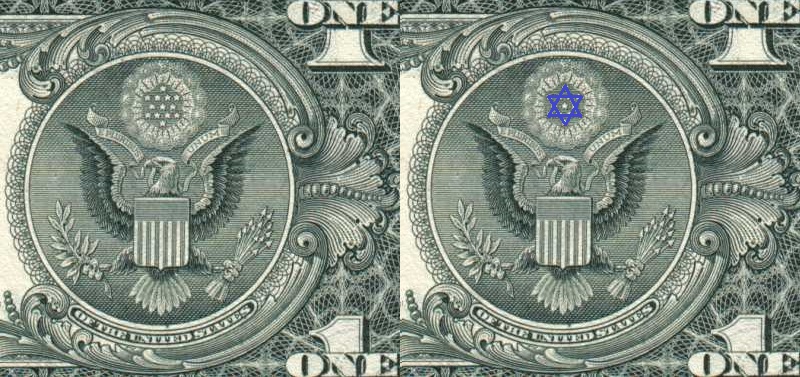
The Great Seal of the United States
The
Great Seal was first used on the reverse of the $1 Silver Certificate in
1935. The Department of State is official keeper of the Seal.
Symbolically, the seal reflects the beliefs and values that the Founding
Fathers attached to the new nation and wished to pass on to their
descendants. Charles Thompson (Secretary of Congress - 1782) explained
the obverse side of the seal this way: The red and white stripes of the
shield "represent the several states...supporting a [blue] Chief which
unites the whole and represents Congress." The colors are adopted from
the American flag: "White signifies purity and innocence, Red, hardiness
& valor, and Blue, the colour of the Chief, signifies vigilance,
perseverance & justice." The shield, or escutcheon, is "born on the
breast of an American Eagle without any other supporters to denote that
the United States of America ought to rely on their own Virtue."
The number 13, denoting the 13 original States, is represented in
the bundle of arrows, the stripes of the shield, and the stars of the
constellation. The olive branch and the arrows "denote the power of
peace and war." The constellation of stars symbolizes a new nation
taking its place among other sovereign states. The motto E Pluribus
Unum, emblazoned across the scroll and clenched in the eagle's beak,
expresses the union of the 13 States. Recent scholarship has pointed out
the probable source of this motto: Gentleman's Magazine, published in
London from 1732 to 1922, was widely read by the educated in the
American Colonies. Its title page carried that same motto and it is
quite possible that it influenced the creators of the seal.
The
reverse, sometimes referred to as the spiritual side of the seal,
contains the 13-step pyramid with the year 1776 in Roman numerals on the
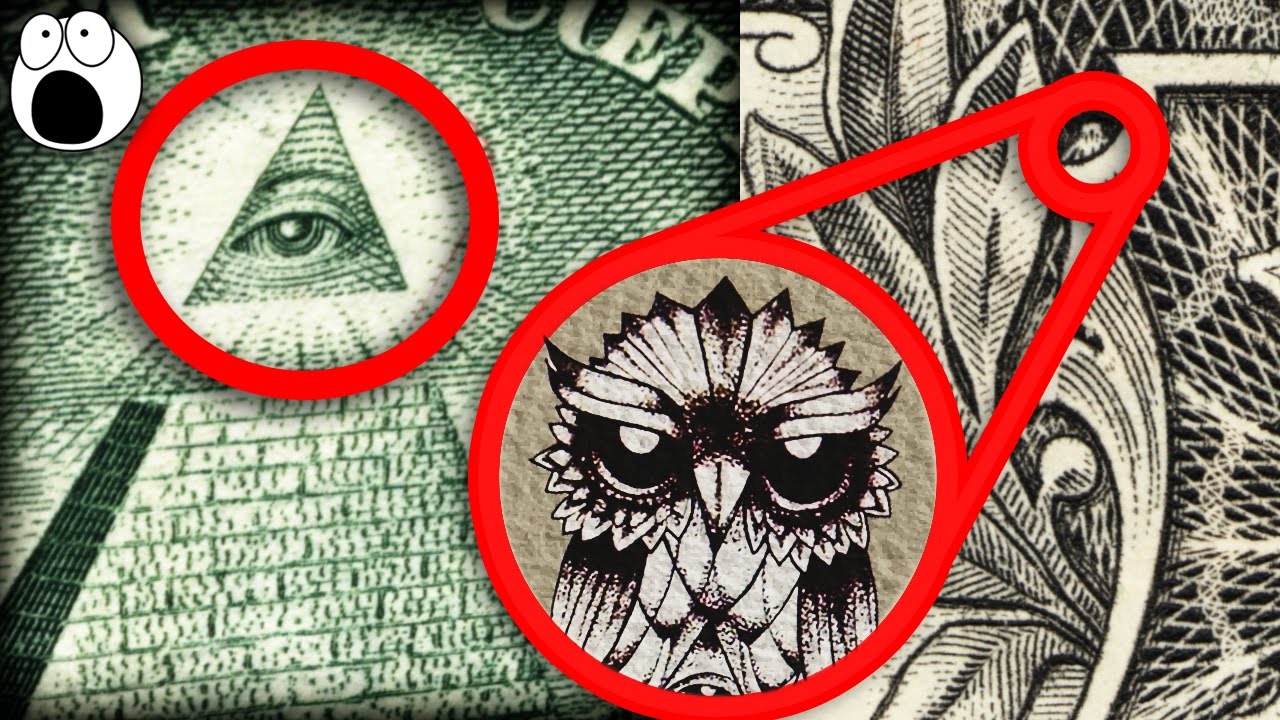
base. At the summit of the pyramid is the Eye of Providence in a
triangle surrounded by a Glory (rays of light) and above it appears the
motto Annuit Coeptis, or "He (God) has favored our undertakings." Along
the lower circumference of the design appear the words Novus Ordo
Seclorum, or "A new order of the ages," heralding the beginning of the
new American era in 1776.
The Production Process
Engraving Production of United States paper currency is not an easy or
simple task, but one that involves over 65 separate and distinct steps
in the production process. Money begins with the hand-engraved piece of
soft steel, known as a master-die. Separate portions of the design, such
as the portrait, the vignette, the ornamentation, and the lettering are
hand-cut by the engravers. If you look closely at a currency note, you
will notice that the portrait consists of numerous fine lines, dots and
dashes which vary y in size and shape. The magnificent artistry and
skill of the engraver bring the portrait to life. The process of
engraving is the first step in a unique printing technique known as
intaglio printing.
Siderography
In simplest terms,
siderography is the means by which multiple images of the hand-engraved
die are transferred to a printing plate. The original dies are stored
and transferred to a printing plate. The original dies are stored and if
necessary may be used again and again. For example, the Lincoln portrait
on the five dollar note was originally engraved in 1869, but can still
be used today in the production of a five dollar note.
Plate
Making
The master die is subjected to tremendous pressure,
heated and an impression of the die is taken. An alto and/or relief (a
raised image of the die) is cast in plastic. Multiple plastic images of
the various components (such as the decorative scrollwork) of the note
are made, fitted and welded into the necessary plate configuration
consisting of thirty-two notes. Plastic altos are placed in an
electrolytic tank and are used to produce a series of plates, which are
then cleaned, polished, and carefully inspected by an engraver. If the
plates pass the scrutiny of the engraver, the final chromium coated
basso (recessed image) plate is made and another multiple subject
intaglio plate is ready to place on the printing press.
Printing
The Bureau prints currency on high-speed, sheet-fed rotary
presses, which are capable of printing over 8,000 sheets per hour. Each
sheet is forced, under extremely heavy pressure (estimated at 20 tons),
into the finely recessed lines of the plate to pick up the ink. The
printing impression is three dimensional in effect and requires the
combined handiwork of highly skilled artists, bank note engravers, and
plate printers. The surface of the note feels slightly raised, while the
reverse side feels slightly indented. The backs of the notes are printed
with green ink, allowed to dry for 24 to 48 hours. The faces are then
printed with black ink and also allowed to dry.
Examining
Each stack of 32-subject sheets is cut in half and each side is
examined for defects. If the sheet meets the examiner's inspection
standards, it is then ready for numbering and processing on the Bureau's
overprinting and processing equipment.
Overprinting
A
letterpress overprints with black ink the Federal Reserve District seal
and its corresponding number designation. It then overprints the
Treasury seal and serial numbers in green ink. Two guillotine cutters
slice the notes into two note units (100 sheets at a time) and finally
into single stacks of one-hundred notes. The units of 100 notes are
banded and packaged into "bricks" containing 40 units; each "brick"
contains 4,000 notes. The bricks are distributed to one of the twelve
Federal Reserve Districts, which issue the notes to local banks. If a
finished note is found to be imperfect after it has been overprinted, it
is replaced with a "star note". In design, star notes are exactly like
the notes they replace, but they can carry an independent series of
serial numbers. The star appears after the serial number in place of the
suffix letter on Federal Reserve notes. The serial number of the
imperfect note is not used again in the same number sequence.
Portraits and Designs on U.S. Currency
The design features on
our currency have historical and idealistic significance, but may not
include the likeness of a living person, and do not have sectarian
significance. The design of paper currency, as well as the material used
in its production, is determined by the Secretary of the Treasury.
Source for most of the content on this page: US Secret Service
|